And the Book Deal Goes To…
I’ve got this new client. Let’s call her Deborah.
Deborah came to me by way of the Rowland Cottage Retreats. Those are the multi-day writing retreats I co-facilitate in Muskoka, which is Canada’s answer to the Hamptons: cottages, lakes, docks, sailboats and motorboats, canoes. 🛶 And loons. I’ve just returned to BC after hosting the week-long Trillium retreat and the two-day Fern retreat, and I’m still catching my breath.
It was such a lovely, transformative time. I’ve got lots to say about it, and I’ve already said a fair bit over on Instagram, so if you want pictures of me and Jen and our people and the venue, they’re all there, with more to come.
I’d like to write about it here at some point, but as time rolls on and as other things press into my calendar and consciousness, I know it’s quite possible that a reflective post about these incredible retreats might be carried away on the rushing river that is 2026.
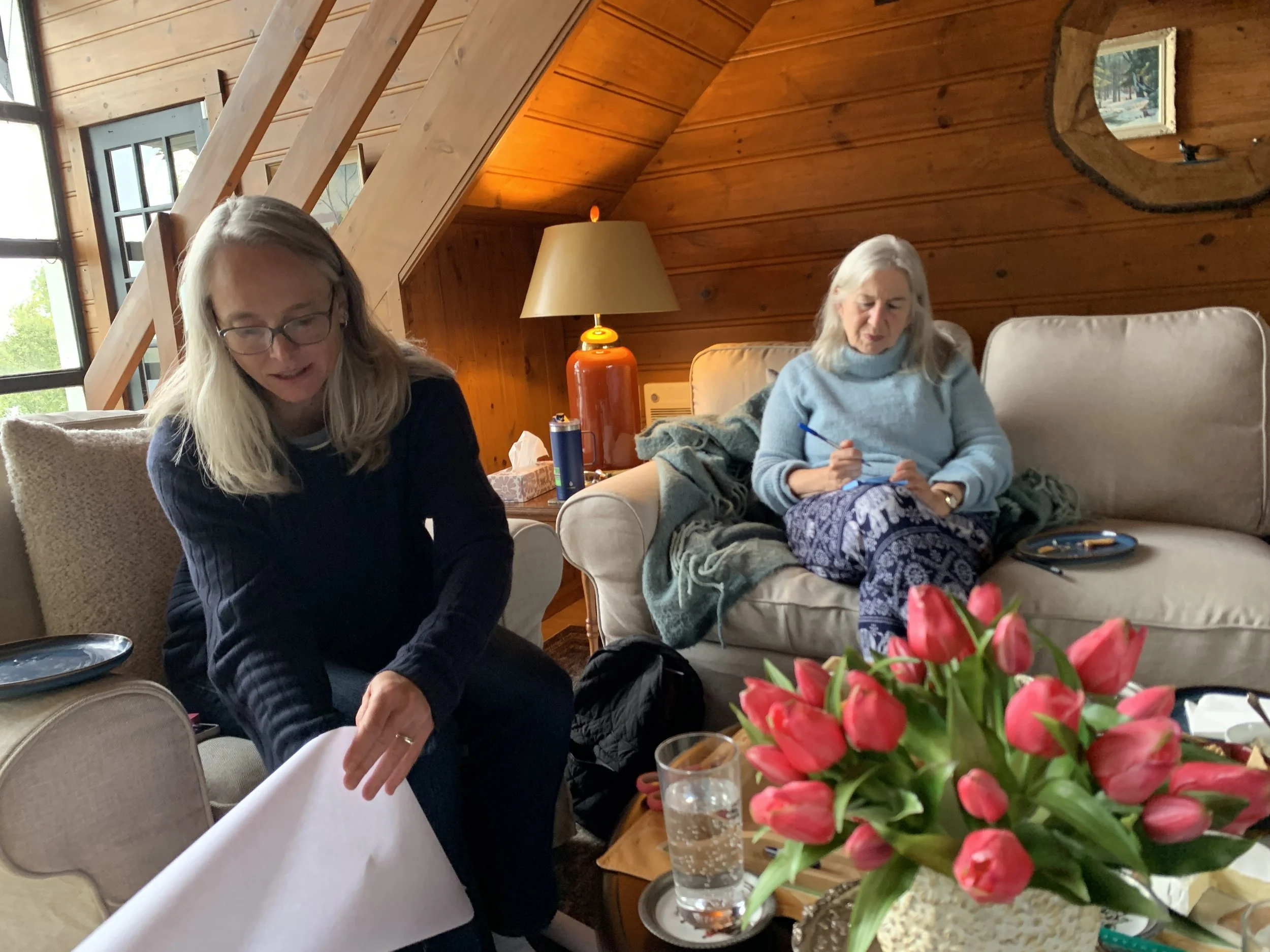
Setting our ground rules on Day 1 of the week-long Trillium retreat (that’s not Deborah lol)
But just know: thoughtful people + stunning lakeside cottage + lots of time in nature + catered food + sauna + night swimming + yoga + canoe coaching + full moon + time to write = an absolutely transportative experience that adds up to WAY more than the sum of its parts.
I feel like the Universe was literally in the canoe with us. It was awe-inspiring.
Where a participant engages me to look at her book
As part of the retreat package, we offer each participant an hour of 1:1 coaching. Jen offers either an hour of executive coaching or a Kolbe debrief. I offer either an hour of somatic coaching (which one person took me up on), an hour-long Human Design reading (which one person took me up on), or an hour of book coaching (which everybody else signed on for, including this lovely new client).
This woman—Deborah—has been out on submission with her first novel for several months now, and she’s wondering why it’s not getting picked up. She’s a career nonfiction writer, having written for several of Canada’s best-known newspapers. Strong writer, huge reader—both necessary components to clear the bar and land a traditional publishing deal.
There are other components, though, and my job is to help writers build them.
In preparation for her session, I agreed to look over Deborah’s query letters and synopsis, and skim her manuscript. I suspected I might find some issues, and sure enough, when I sat down with her pages, I did. Being a strong writer in the nonfiction space doesn’t always translate easily to telling an amazing story in the fiction category.
I made some notes to talk through during our 1:1, and by the time we’d spent an hour going over the expectations of agents and publishers, the recent shifts in the literary marketplace, and the need for even historical fiction to be relatable to today’s readers through emotionally captivating characters and problems, Deborah realized it was time to invest in having her work thoroughly looked at by a professional editor. Which she’d never done.
Where the participant engages me to evaluate her book
Now, you might have just rolled your eyes at that last statement, thinking that of course an aspiring novelist should have invested in at least a couple rounds of editing before going out on submission. But the truth of the matter is that many writers—many thousands of writers—don’t. Very often, people don’t know what they don’t know. I find this is the case with nearly every person who walks through my doorway.
I mean, I published all of my books without once paying an editor to give any of those manuscripts a thorough scrubbing. So it’s not uncommon. (I did receive editing from the in-house editors at each of the publishing houses I worked with. But unless your manuscript is strong to begin with, you can’t even get a foot in the door these days.)
Of course, I’ve learned since then, and now I have a book coach of my own, and my butt is still sore from the kick she gave me in yesterday’s feedback that my plot is dragging. DRAGGING, people. Fifteen published books and I STILL write scenes that bore the knuckles off readers.
Where we buckle in, because there’s work to be done
So Deborah engaged me to do a manuscript assessment—the first step in figuring out whether we’re dealing with something that’s market ready, a page-one rewrite, or somewhere in between.
It might be a page-one rewrite; I’m only 50 pages in, so I don’t know just yet how much we can salvage. But she’s got a terrific story idea, and there’s definite market appeal if it’s told well. If she can revise this book to have better pacing, higher emotional stakes, more dimensionality to her characters and more grip to the protagonist’s central struggle, she’ll probably be able to sell it.
With my 300-page homework assignment in hand, I assigned Deborah her own little piece of research. Knowing that she’s been working on this book for almost 40 years and knowing she’s not going to want to spend another three pulling it back to the studs in order to rebuild it, I decided one of the fastest ways to teach her the missing skills is to raft up alongside a couple already published books that she enjoys and that she would like her book to emulate.
That’s fancy speak for “We’re going to use other authors’ writing to get her writing to sound better on the page”.
But Alex, that’s COPYING!!
Hang on. Hold the—
Just hold the phone a sec.
No, it is not.
Let’s think about other careers where skill meets art. Football coaches replay parts of the game so the players can see what worked and what went sideways. Young divers improve by studying game film from others who have gone before them. Kobe Bryant studied tapes of Michael Jordan for YEARS to understand his footwork and defensive stances.
And he copied him, move for move.
Sarah McLachlan didn’t just sit down and hit record one day and turn out multi-platinum-selling music albums. She sang a lot of other people’s songs as part of her training back in her Halifax days. Opera, as a matter of fact.
We get better by studying, emulating and then, eventually, diverging from the greats.
So taking Deborah straight into the authors she loves and admires is one of the most efficient ways we can improve her writing.
Where I share with you the astonishing depth to which this human took the task
Not two days after I set her this assignment, I received an email that showed me this woman is an absolute dream client. She’s one of the curious, reflective and growth-minded types I so love to work with. I’ve edited her email for brevity, but let’s just have a look at the way she’s taking her art seriously:
— open transmission —
Here are my 2 books - with some observations/reflections from my process below. The exercise left me with a lot to think about!
TWO RECOMMENDATIONS
Gail Anderson-Dargatz’s THE ALMOST WIDOW.
She’s an Alberta writer who’s been doing much slower-paced literary fiction, but this one reads like a thriller. I loved it so much that I actually emailed her after I finished reading it and told her she hadn’t missed a beat. Her writing and endings are much better than Shari Lapena, who turns out a thriller/year.
Colm Toibin’s BROOKLYN.
I wrestled with whether #2 should be Uzma Jalaluddin’s DETECTIVE AUNTY or BROOKLYN. Your instruction was to give you two I “loved”. I loved DETECTIVE AUNTY, but it seemed too much like THE ALMOST WIDOW since it's a great read with a fast-paced mystery, though she falters in the resolution.
I thought I should go with BROOKLYN, which I enjoyed but wouldn’t say I loved, to show you what I appreciate in a more “relationship” book, which is what I’ve been trying to write. But, I remember Carol Shields saying “write the book you want to read!” So, it may be that this exercise has made me realize that what I really love is the fast-paced books - even more than the “readable literary” ones - and somehow I have to find a way to write mine that way. :0 Up to now, I’ve thought those were just escapism, not “real” literature, so in second place.
REFLECTIONS FROM THE PROCESS
As I noted the other day, this has been an interesting exercise. I went through my shelves & reading list from the last three years & discovered:
Strong stories with women’s voices, sometimes ground-breaking for their times:
* Margaret Atwood’s THE HANDMAID’S TALE. I loved the women’s futuristic perspective when I read it in the 1980s, but its start now feels slow/plodding.
* Marilyn French’s THE WOMEN’S ROOM. She’s still got a good opening para, & I still love the women’s story, but then it goes into that 1970s/80s writing plod.
* Margaret Laurence’s THE FIRE-DWELLERS. I loved the honest women’s voice, so revolutionary at the time, but now the writing also feels slow/plodding.
* Marion Zimmer Bradley’s THE MISTS OF AVALON. Another woman’s Druidic style voice, but also more plodding now.
* Tatiana de Rosnay’s SARAH’S KEY. She has a wonderful opening, but I didn’t like the two-voice (alternating chapters: past/present characters) style.
Stories of ordinary people and their relationship/personal challenges, usually with a social, historical, or cultural context that I feel I’ve learned something from:
* Canadian:
-Dennis Bock’s THE GOOD GERMAN. I liked his telling of the reality of post- WWII German immigrants to Canada & what they faced as I saw echoes of that in my small MB town in the 1960s.
-Esi Edugyan’s HALF-BLOOD BLUES about black jazz musicians in pre-WWII Europe & WASHINGTON BLACK, a young black slave’s coming of age story.
-Katherena Vermette’s THE BREAK, an Aboriginal story from Winnipeg, which portrayed that women’s reality very well. Eye-opening.
-Linda McQuaig’s first novel, THE ROAD TO GODERICH, a historical Ontario pioneer story about a Brit who comes over as a minister’s wife. It’s good on the early provincial history, but weak on the minister’s wife story.
* British
Colm Toibin’s BROOKLYN & NORA WEBSTER. I liked his telling of everyday women’s stories, though they feel a bit male-written. I picked his over the four below because I thought he had a more engaging entry into his novels than some of the others.
* US
These are the ones I wrestled with whether they should be #2:
-Anne Patchett’s TOM LAKE, which I recommended a friend read.
-Anita Shreve’s THE PILOT’S WIFE. I liked the relationship interplay in the story: husband dies, grieving wife discovers he has another family.
-Sue Monk Kidd’s THE SECRET LIFE OF BEES. Slow start, but I loved the 1960s southern US white-black relationship & the strong black women in it.
I’ve also read a lot of political non-fiction, especially as I try to understand Trump & the current US situation, spirituality practice books, bios, memoir, historical fiction, thrillers (Shari Lapena) & mysteries (Louise Penny) - the last 2 of which I'd never read before. I used to read more Cdn fiction, but now seem to find some of it plodding (“literary”) and want a lighter, faster-paced story at the end of my writing day.
What I want to write is:
* a strong woman’s story from a little-known context (rural prairie manse life)
* some historical context (the [redacted…I gotta keep some stuff secret!], 1970s, rural prairie mental health facilities then)
* strong relationship/personal challenges
* deep enough to be meaningful, fast-enough paced to be readable.
I’d never thought of what I read in this kind of context before, and it’s making me think about what changes I could make to my book.
—end transmission—
RIGHT???
[dabs tears]
I want to dance all night long 🪩 when people who want to write and publish a book take their learning and writing this seriously.
Not only is Deborah taking her art seriously, she’s using this assignment to reflect on herself as a reader. This is the single biggest mindset shift I guide people through, is to learn how to think about their book from the perspective of the person who’s going to be reading it. A surprising number of writers don’t. It’s just a thing with writing; every book coach and editor sees it.
But. If you make underwear for people and you don’t ever put on a pair yourself to see how they fit and feel, how do you imagine you’ll nail the fit and feel for somebody else? If you design kitchens and never walk around inside them to see whether there’s enough space between the island and the fridge, how do you imagine you’re achieving results that delight your clients? If y—
Okay.
Where I tell you I’m in it for the nerds
I share this with you to show how even just thinking about what kind of book you want to write and what makes other books interesting…makes you a better writer. So much of this metier involves reading and contemplating other works, comparing your writing to the writing of others, and learning from other people in order to make your own work better. There is nothing different about learning how to write a book than other professions that feature apprenticeships or residencies or practicums. Humans learn by emulating, by doing, by studying, by reading, by watching.
I’m so excited to work with this woman, and to see where she’s able to bring her book. The clients who give their writing the most time and care are always the ones who show the most notable improvement.
Such a stoke.
#Initforthenerds