Excellent writing is what makes a book memorable. It’s what gets aspiring authors off the slush pile, it’s what compels readers to keep reading, and it’s what makes people recommend your book to their friends.
For an author, this is the holy grail, this passing along of a book via word of mouth.
One way to elevate your writing into WOM territory, no matter the genre, is to use very specific details to illustrate whatever you’re talking about.
Let’s look at a nonfiction book I’ve just started reading. I put it on hold at the library a few weeks ago because it’s one of my writers’ comp titles. (He’s writing a book about rewilding, and is voraciously reading all around his topic. This, by the way, is how to get off the slush pile. You should be reading unreasonable numbers of books, both inside and outside your category.)
The book in question is called AWE: THE NEW SCIENCE OF EVERYDAY WONDER AND HOW IT CAN TRANSFORM YOUR LIFE. It’s written by Dacher Keltner, who founded the Greater Good Science Centre at UC Berkeley. I’ve paid attention to Greater Good’s work here and there over the years, so I was delighted when I discovered Keltner’s association with a research institution that studies and teaches the importance of love and happiness.
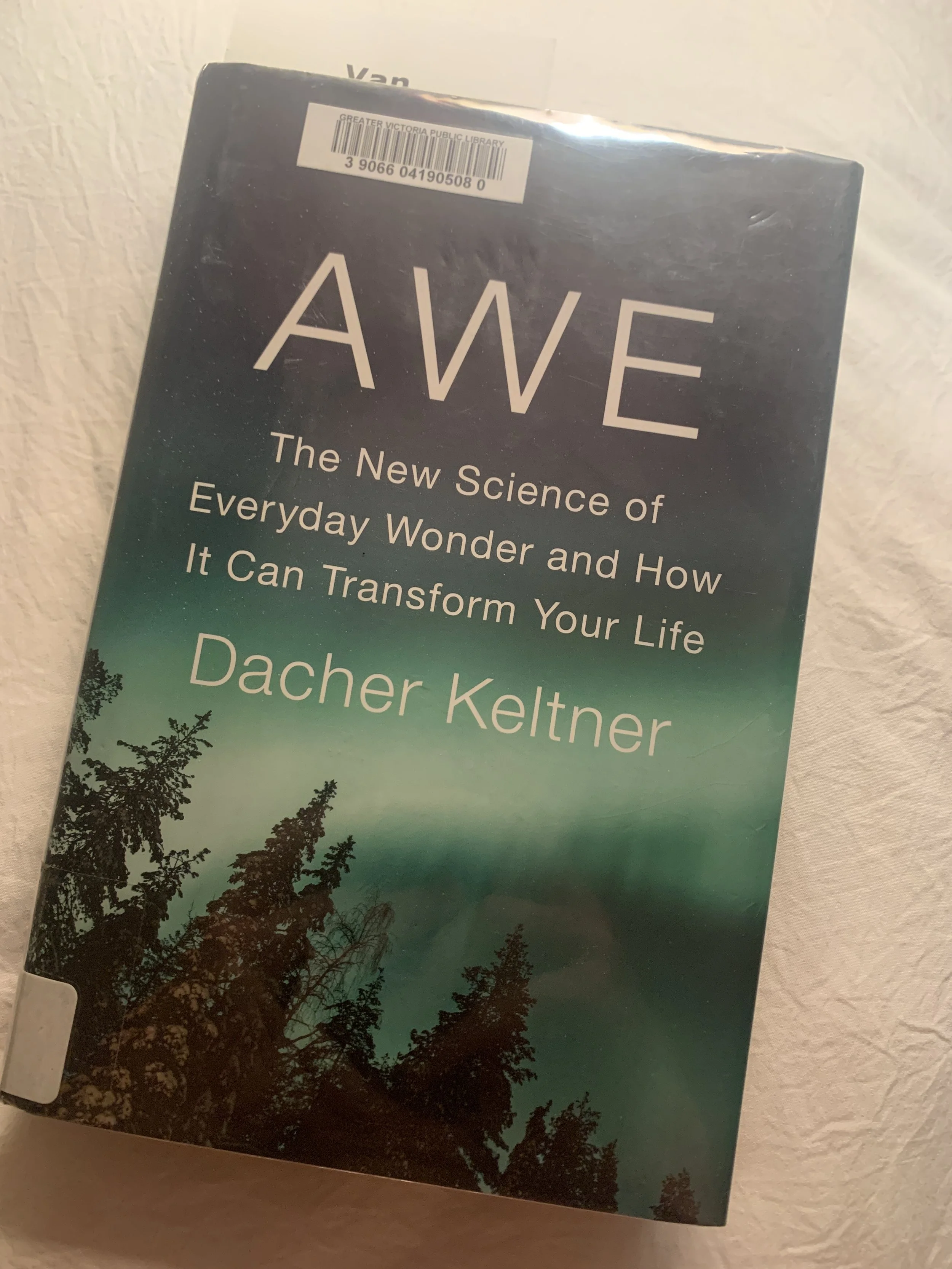
I read all the blurbs before I opened the cover, which I don’t tend to do because they never impact my decision to buy a book, however another book coach recently mentioned that she buys books on the strength of the blurbs, and so I’ve humbly added this to my ever-growing store of knowledge about what informs buying behaviour. (It never ends, guys. It never ends.)
I read the jacket copy. (Personally, I’d have led with the fact that awe literally mitigates our body’s inflammation response, because that’s immediately appealing and relevant to a lot of readers, but Penguin knows what it’s doing and they chose to lead with easily grasped, well-known experiences that conjure awe. Solid choice.)
And then I read Keltner’s bio on the back flap, all before I touched the pages themselves.
Then I turned to the front of the book and started reading.
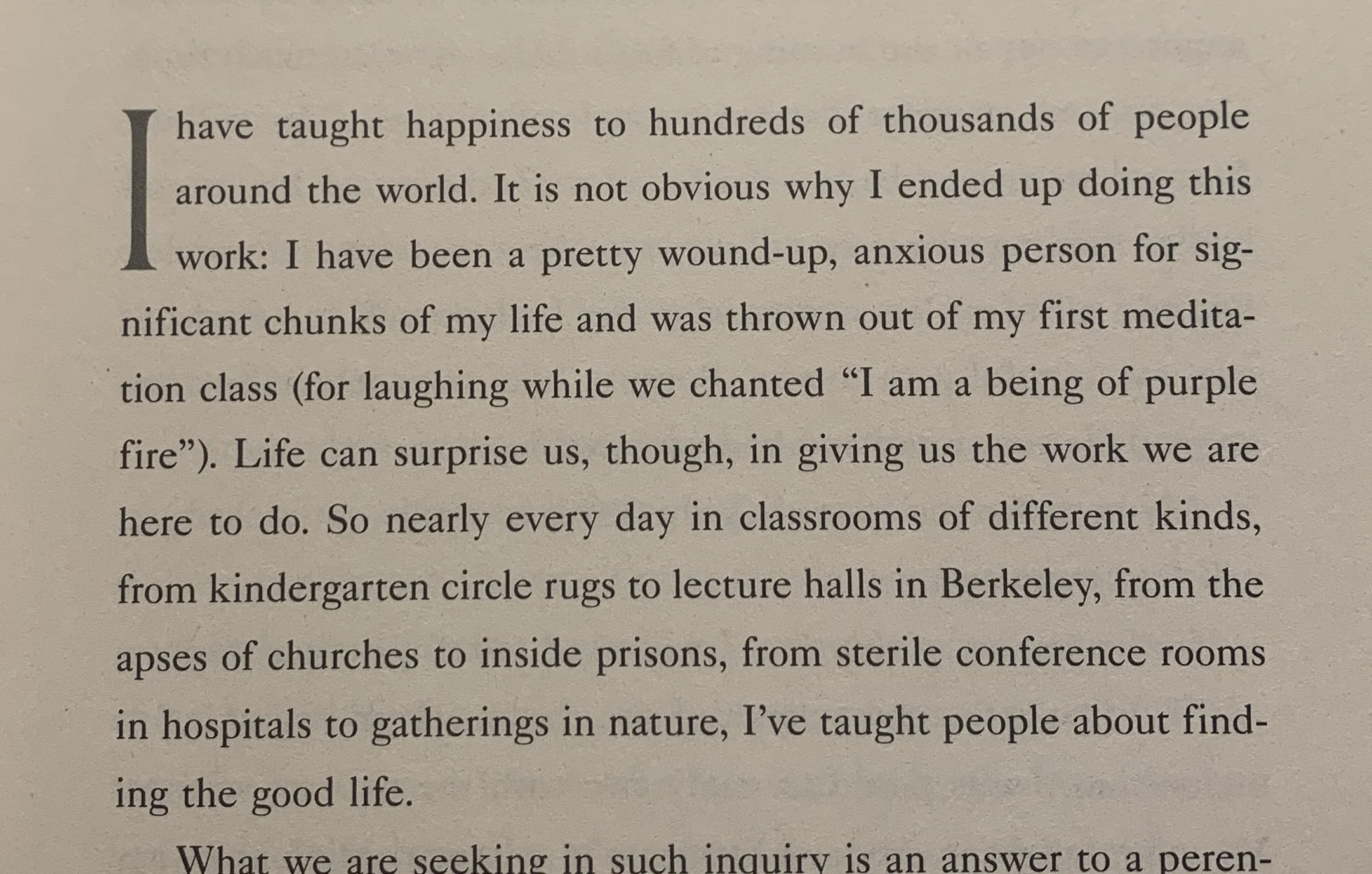
The passage we’re looking at today comes from the Introduction. In fact, the phrase that caught my eye, delighting me and promising a very good reader experience ahead, was tucked neatly into the second sentence of the Intro.
Have a look:
Wow. Masterful strategy.
Let’s get into it.
The sentence in question reads:
It is not obvious why I ended up doing this work: I have been a pretty wound-up, anxious person for significant chunks of my life and was thrown out of my first meditation class (for laughing while we chanted “I am a being of purple fire”).
There’s so much I can say about this sentence, so strap in. It’s like a matryoshka doll, with layer upon layer of nuance to discover.
Layer 1: It made me laugh.
I read this phrase:
…and was thrown out of my first meditation class (for laughing while we chanted “I am a being of purple fire”)
three times. Twice in isolation, and once again starting from the beginning of the sentence. I’ll often loop back in a book if I liked what I just read, can’t believe what I just read, find a juxtaposition to be provocative, or want to read a particularly artful line again.
In this case, it was the provocative juxtaposition of a high-strung person giggling during meditation. Even though I understand the point and significance of the chanting, I also totally get why Keltner found it absurdly funny. A being of purple fire?
And because I was picturing Keltner in my mind, rocking back and forth and chanting and trying to keep his laughter in but making a squealy farting sound through tightly sealed lips as he tried to stifle his hysteria…yeah. Funny.
Layer 2: This sentence makes the reader curious.
An instant forest of questions sprouted in my mind upon reading this sentence, especially with that parenthetical statement where he gets ejected. In the span of maybe half a second, my brain covered all this terrain:
They can throw you out of meditation classes??
How old was he when he took this class?
Why purple fire? I’ve never heard about this purple fire. Is that a tantric thing?
What does it even look like to get thrown out of a meditation class? I can’t picture a meditation teacher throwing anything anywhere.
Our brains are so fast. We’re capable of reading, questioning, comparing, empathizing and doubting ALL AT THE SAME TIME. Your reader’s mind is more sophisticated than a room full of servers. Never underestimate their ability—or their bar.
In the case of AWE, my questions don’t arise from confusion. I don’t need them to be answered in order to understand what Keltner is saying. But, as any reader would, I will now leaf through the pages accompanied by the pleasant hope of uncovering more clues that might answer them.
Sparking curiosity in your reader is a brilliant strategy. Curiosity is the flywheel that keeps you engaged throughout the reading of any book. If you don’t care how it turns out, you’re not going to read it.
In a well-written memoir, we’re curious about how the author manages to work through the tough hand they were dealt.
In a well-written novel, we’re curious about what this person means to that person, why this person did this thing to that one, and how the protagonist is ever going to solve the problem without Auntie Nan finding out.
In a well-written nonfiction book, we’re curious about the science, the findings, the case studies, the possibilities, the guidelines for how to replicate a successful result for ourselves.
Keep them curious.
Layer 3: Readers find incongruity intriguing.
This is not me saying readers like to be confused. No, no, no. They really don’t. Too many loose ends and unanswered questions (i.e. questions that matter to the reader’s ability to understand what they’re reading) will discourage the reader and they’ll put the book down.
But people do find a bit of well-handled incongruity to be captivating.
The incongruousness of being an anxious, high-strung person, yet bursting into laughter during a very serious spiritual moment is so interesting. Counterintuitively (so much in literature is counterintuitive—it’s art, after all), it built my trust in the author, because right here on page one, he’s confessing that he’s just as much of an idiot as I am with these sorts of things. He’s a flawed, fascinating human, just like me.
And I want to follow him to see where else he’ll take me.
Layer 4: It told me a great deal about the author.
With just a few well-placed words—anxious, wound up, significant chunks of my life—I quickly captured a meaningful snapshot of much of Keltner’s history and character. Anxiety behaves like a drop of dye in a glass of water: nondiscriminatory in nature, it permeates throughout a person’s entire life. If it shows up in your relationship with time, it’ll usually also show up in your relationship with academic achievement, dealing with the outside world, handling root-level insecurities in romantic relationships, and worrying about the cost of getting the sunroof repaired on your 2020 Toyota Camry.
See that last phrase there? The one about the 2020 Camry? That’s the level of specificity that makes your writing pop to life and jump off the page. It’s the level of specificity that Keltner deploys in AWE, showing us laser-tight glimpses of things that our minds can easily picture.
Writing is art. And art…takes time.
My hope is that you’re surprised at this post. Surprised at the many layers of meaning that good writing can carry.
And that was just one sentence.
This is why writing a book—and writing it well—takes a great deal of time and patience. It takes the ability to ask yourself at every turn: What will make this idea come alive for the reader? How can I clearly render this thought onto the page? In what order should I arrange the words for maximum impact? Will my reader take away the full meaning of what I’m saying?
Because you want your book to be good, right? You want it to travel hand to hand out there in the world. You want it to change people’s minds, loosen their grip on the bullshit in their heads and instead live more from their hearts, inspire them to stand up for something important.
You want your message to carry power.
You want to write something that matters. That lasts.
Writing is art. And art…takes time.
And, unlike the other arts, all we have as writers to create meaning is the word. We only get to use one tool, over and over and in different combinations—and so we need to deploy it strategically, artfully, intelligently. We don’t get lighting and a set and costumes and canvas and different colours of paint and a mixing board and percussion and a xylophone and a sexy lead singer who carries the whole thing.
We get a word after a word after a word.
But as Margaret Atwood said, A word after a word after a word is power.